



Five major services went down in six days this month: Outlook, the FAA, Chase, the NSA's network and Apple. Each outage started with a change the company made to its own systems, and officials say none was an attack.
They all came during a rush to patch. AI tools now find security holes faster than companies can safely fix them, and the testing that catches a bad fix is getting squeezed.
Here's what happened, why it's happening, and six steps that keep your team working the next time a service goes down.
Five outages hit in six days
In Hawaii, the first one started at about 6 a.m. on Thursday, November 12, when Outlook stopped working.
- Thursday: Outlook and Microsoft 365. People in 74 countries reported problems on Downdetector (Al Jazeera). Microsoft traced the outage to a defect from a July update that sat unnoticed in its email servers for more than three months. When it tripped, more than 80% of those servers stopped responding (The Next Web).
- Friday: the FAA. Departures stopped across the country for more than four hours. A newly installed router flooded the air traffic network with connection attempts, and the FAA paused router installs while it confirms the cause (AP via MPR News).
- Monday: Chase. Payments and Zelle transfers slowed for most of the day. Chase blamed a software bug in its own systems and said customers kept access to their accounts and funds (CNBC).
- Tuesday: the NSA. The agency's classified network went down during what it called routine maintenance. A U.S. official tied it to the sheer volume of patching (CBS News).
- Tuesday: Apple. iCloud, Apple Pay and the App Store went down after what Apple called an internal update (TIME).
The cost of a morning without email adds up fast. Anderson Economic Group's early estimate puts the lost productivity from the Microsoft outage alone at about $7 billion (Security Magazine).
How would your office handle a morning like that? We can help you plan for it.
Why are so many services going down at once?
AI is finding security holes faster than companies can fix them.
In April, Anthropic, the company behind Claude, announced Claude Mythos Preview, an AI model that finds security holes in software. It shared the model with the U.S. government and a small group of large companies, including Microsoft, Apple, Google and JPMorganChase (Anthropic; SecurityWeek). By May, those companies had found more than 10,000 high or critical-severity bugs (Anthropic).
Think of a home inspection that turns up a thousand repairs in one afternoon. Each repair makes the house safer, and each one still needs a crew and a final check.
The repairs are piling up:
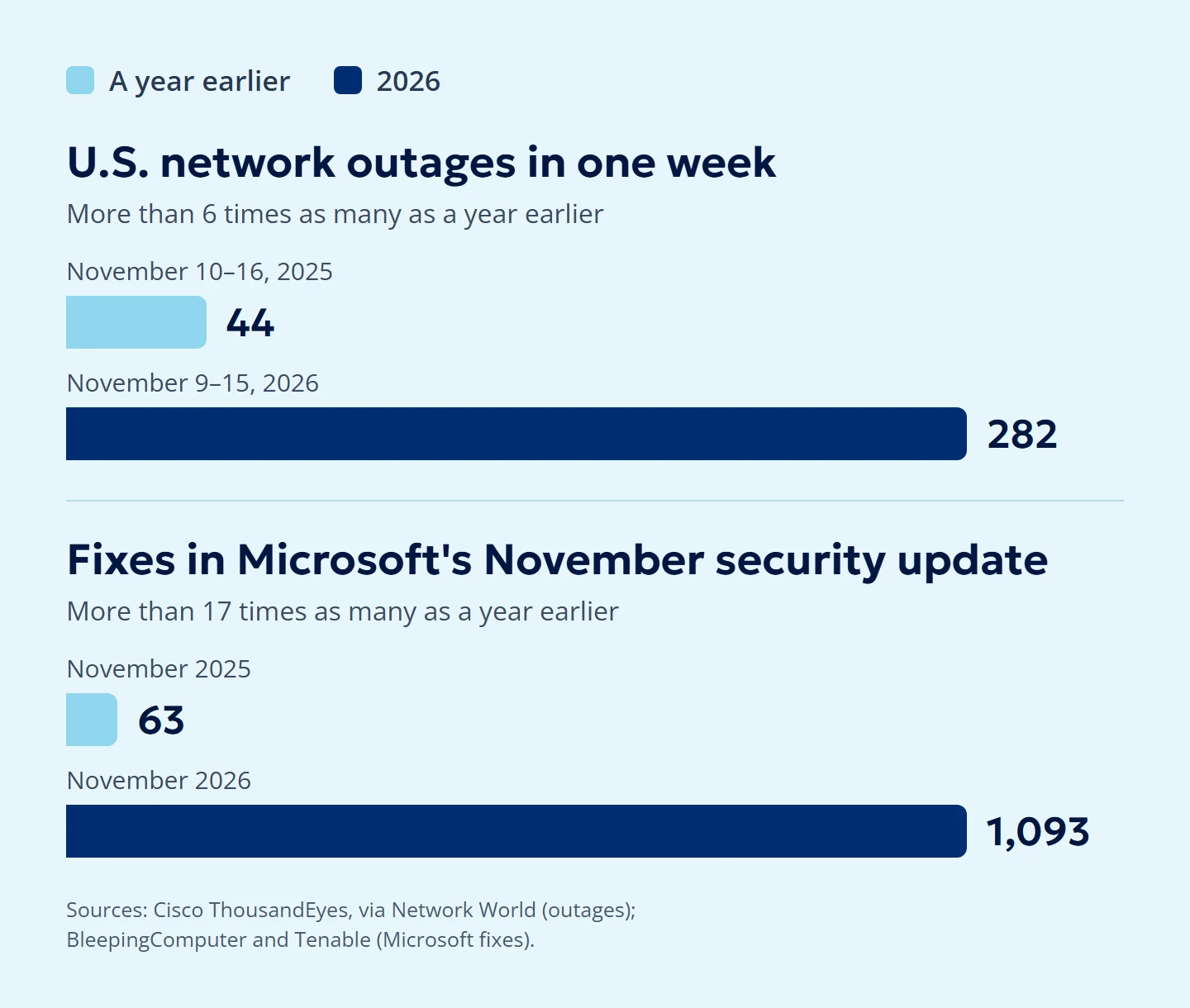
- Microsoft's monthly security update grew from 63 fixes in November 2025 (BleepingComputer) to 1,093 in November 2026 (Tenable).
- Bank of America brought on 1,000 contractors to help with patching (CNBC).
- Cisco ThousandEyes counted 282 U.S. network outages in the week of November 9, 2026, up from 44 in the same week a year earlier. Each of the last four weeks topped 230 (Network World, 2026 and 2025).
Why do faster fixes break things?
Security leaders are asking everyone to patch faster. In May, Anthropic told network defenders to shorten their patch testing and deployment timelines (Anthropic). JPMorganChase's technology leaders urged companies to fix critical internet-facing holes as fast as they can (JPMorganChase).
The deadlines are shrinking too. When someone reports a security hole, the software maker gets a set number of days to fix it before the finder makes it public:
- Anthropic is cutting that window from 90 days to 30 for serious holes it reports from January 1, 2027 (Anthropic).
- Google's Project Zero moves to 60 days in February 2027 and 30 in January 2028 (SecurityWeek).
Testing is the step that catches a bad fix before it reaches your office, and it's the step getting squeezed. Google's Project Zero wrote that patching quickly and avoiding buggy patches pull against each other (Project Zero).
The numbers show it. When the security firm Trail of Bits reviewed more than 130 of its own engineers' patches, about one in six broke something else (Trail of Bits). Microsoft's November update broke Windows activation and needed emergency fixes (BleepingComputer).
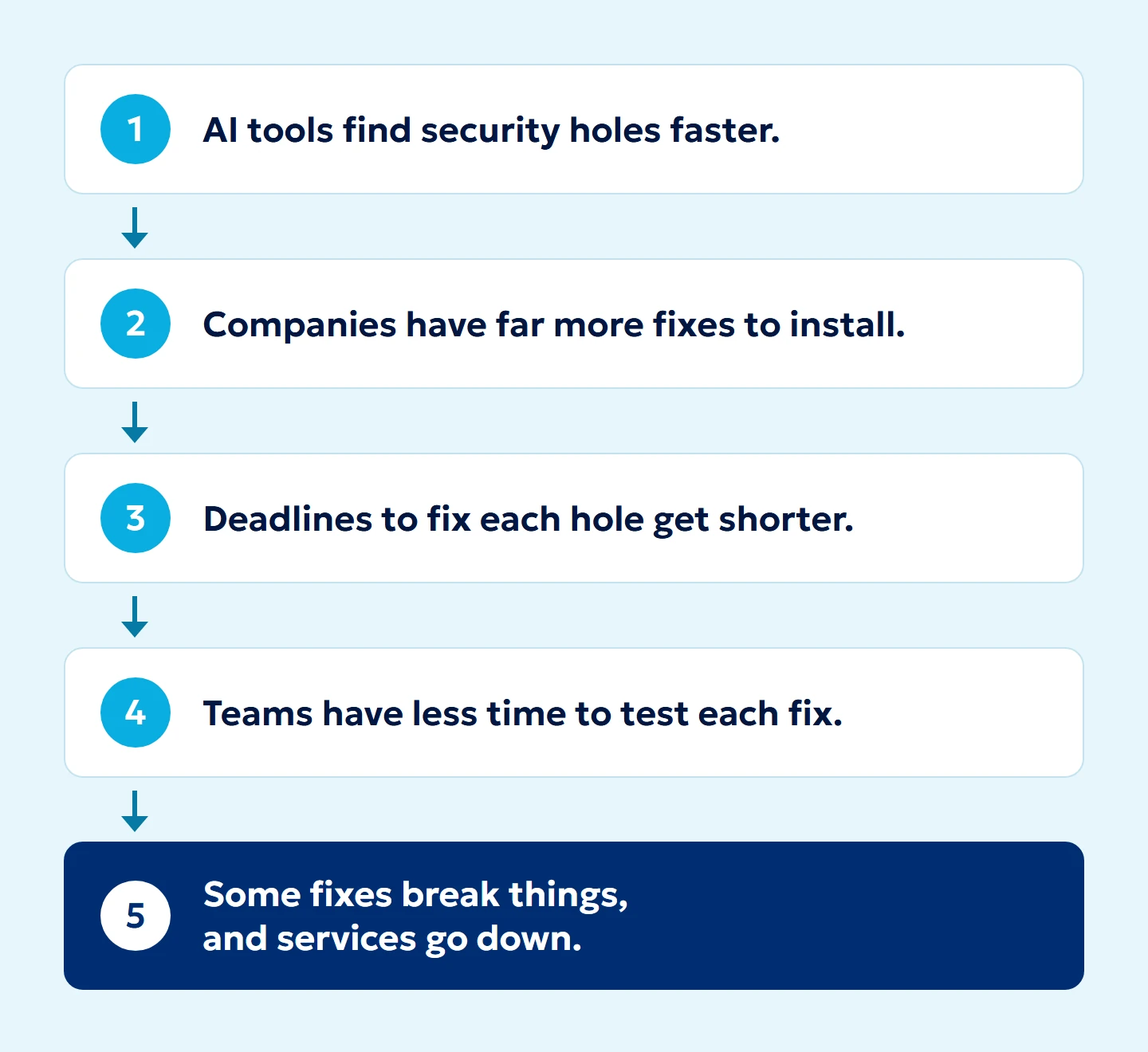
Officials have tied only the NSA outage directly to the patch rush. Microsoft's defect dates back to July, and the FAA is still confirming its cause. What the five share is timing: each began with a change to the company's own systems while everyone is patching more, and faster.
How long will the patch rush last?
Jason Clinton, Anthropic's deputy chief information security officer, warned in August of a coming "vulnerability tsunami." In October he wrote that things will get worse before they get better, and that we need to hold on for about 18 months (ABC News).
Every hole fixed is one attackers can't use, so the rush is making the software your business runs on safer. It also means the cloud services your team relies on will go down more often for a while. A little planning keeps your team working when one does.
Six steps keep your team working through the next outage
- Set up a second way to reach your team. If email goes down at 6 a.m., how will your staff find out? Agree on a group text or a phone list for urgent messages, because alerts sent only by email stop when email stops.
- Write a one-page outage plan. Note how you'll take payments if your bank or card processor is down, where client phone numbers live outside your email, and who calls whom. Want a plan your team has practiced? Our cybersecurity programs include a written disaster recovery plan from our Fractional CISO, plus an incident response tabletop exercise every year.
- Keep updates on a schedule. Each update closes holes attackers could use, so keep installing them. With managed IT, we run updates and reboots after hours on a schedule and fast-track critical security fixes ahead of it (proactive maintenance). Your computers get patched while the office is closed.
- Keep backups you can restore. With managed IT, we back up your servers, Microsoft 365 and Google Workspace data, and employee computers every day, encrypted, with offsite or cloud copies. We test a restore every year, so if an update goes wrong, servers can be brought back quickly from backup images (backups and disaster recovery).
- Add a backup internet connection. Need your office online when your provider isn't? We can set up internet failover, a second connection that takes over if the main one drops, and manage it with the rest of your network.
- Know which AI tools your team uses. The AI tools your staff use are cloud services too, and they change every month. Our AI team's Managed Intelligence Program gives leadership software that shows every AI tool in use across the company, an AI use policy that names the approved tools, and regular office hours that keep your team current.
When something does break, managed IT clients can call our help desk. We answer 90% of calls in 90 seconds or less, Monday to Friday, 8 a.m. to 4 p.m. Hawaii time, and our after-hours emergency line reaches on-call engineers.
Want us to handle the updates, backups and backup internet for your office? Call 808.468.4244 or reach out below.
Questions Hawaii businesses are asking about the outages
Was the Microsoft outage a cyberattack?
Microsoft said the November 12 outage was a technical issue unrelated to cyberattacks or AI agents (ABC News). Its preliminary report traced the outage to a defect in a July update to its email servers.
Why are so many services going down at once?
Each of the November outages started with a change the company made to its own systems. They came during a rush to patch, as AI tools find security holes faster than companies can fix them and the deadlines to fix them get shorter.
Should my business keep installing updates?
Yes. Updates close the security holes attackers use. Run them on a schedule after hours, fast-track critical security fixes, and keep backups you can restore in case an update goes wrong.
Will there be more outages?
Expect more for a while. Anthropic's deputy chief information security officer expects the wave of AI-found security holes to last about 18 more months, and U.S. network outages have topped 230 a week for four weeks running.
How can a Hawaii business prepare for a cloud outage?
Set up a second way to reach your team, write a one-page outage plan, keep updates on a schedule with tested backups, add a backup internet connection, and know which AI tools your team uses.
Keep your team working when the next service goes down
Talk with IT Hawaii about your outage plan, your updates and your backups. Call 808.468.4244 or contact us below. We support businesses on Oahu and Kauai, and our cybersecurity programs are available statewide.